Quick Overview
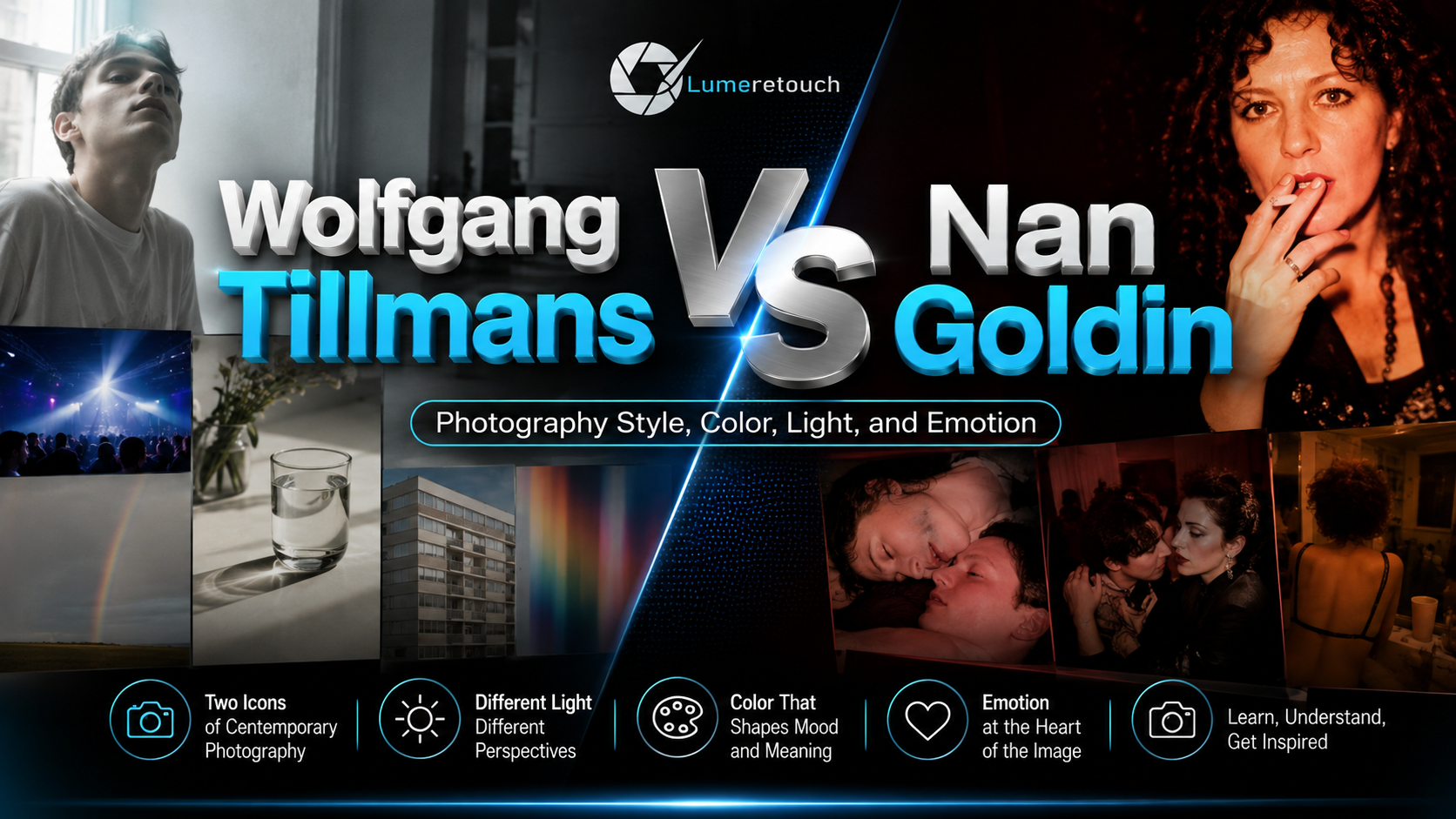
Wolfgang Tillmans vs Nan Goldin reveals two distinct ways of photographing real life: intimacy and personal freedom.
Tillmans often observes people, places, and objects with openness, while Goldin builds visual stories from close relationships.
Tillmans moves between natural light, nightlife, still life and abstraction, while Goldin often embraces direct flash and rich colour.
Both photographers value emotional truth, imperfect moments and people who live outside conventional social expectations.
You can learn from both artists without copying them by understanding how light, colour, trust and editing shape their images.
What Is the Main Difference Between Wolfgang Tillmans and Nan Goldin?
The main difference lies in how each photographer enters the lives shown in the photographs.
Wolfgang Tillmans often works as an alert observer. He notices a person resting, clothes hanging on a chair, light falling through a window, people gathering in a club, or an ordinary object that suddenly feels important. His photographs may look casual, but his choices of scale, colour, sequence and presentation give them careful visual structure.
Nan Goldin often photographs from inside the relationship. Her friends, partners and chosen family do not simply appear as subjects. They form part of her life. Her images feel like private memories that you have permission to witness.
Thiscomparison between Wolfgang Tillmans and Nan Goldi,n therefor,e goes beyond camera settings. It explores two different relationships between the photographer, the subject and the viewer.
Both artists changed contemporary art photography by showing that ordinary life, imperfect rooms, friendships, bodies, desire and emotional tension could carry the weight of serious art.
Who Are Wolfgang Tillmans and Nan Goldin?
Wolfgang Tillmans is a German photographer whose work covers portraits, nightlife, architecture, still life, political documentation and camera-free abstraction. He studied in Britain and became closely connected with European fashion magazines, music culture and club communities. MoMA describes his practice as an ongoing experiment with what photography can show and how viewers experience the world.
Nan Goldin is an American photographer known for recording her own life and the lives of the people closest to her. Her major slideshow, The Ballad of Sexual Dependency, combines photographs of friendship, love, nightlife, desire, conflict, addiction, and loss. MoMA presents her pictures as diary-like records of life as people experienced it, rather than as distant social observation.
You may connect both artists with candid photography, but neither artist simply points a camera at random moments. Each one makes deliberate choices about trust, timing, colour, light, printing and presentation.
How Does the Wolfgang Tillmans Photography Style Work?
The Wolfgang Tillmans photography style values attention more than spectacle.
Tillmans can photograph a friend, a dance floor, a folded item of clothing, a landscape, a window or an abstract field of colour. The subject changes, but his curiosity remains consistent. He asks you to look closely at things you might normally ignore.
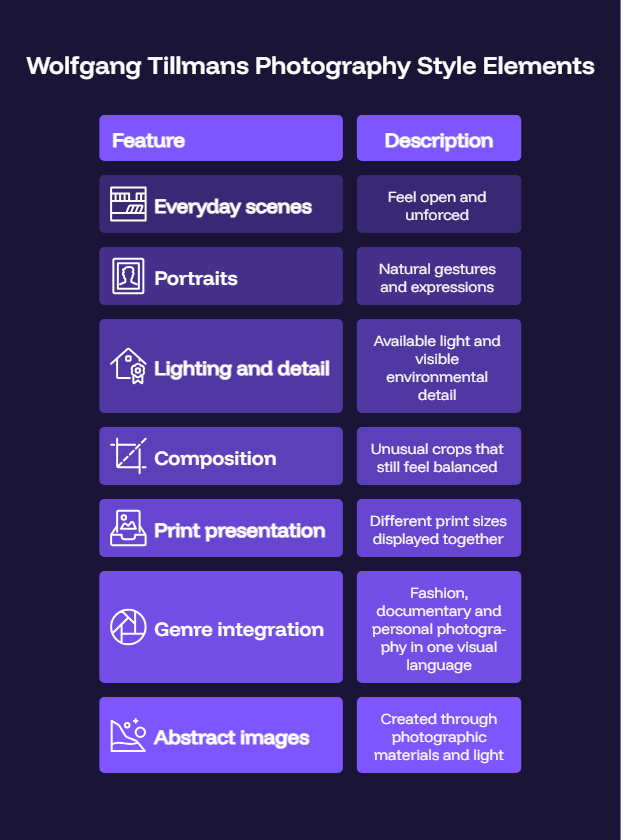
His work often includes:
- Everyday scenes that feel open and unforced
- Portraits with natural gestures and expressions
- Available light and visible environmental detail
- Unusual crops that still feel balanced
- Different print sizes displayed together
- Fashion, documentary and personal photography in one visual language
- Abstract images created through photographic materials and light
Tillmans does not limit himself to one genre. MoMA has presented his work across nightlife, intimate portraits, social movements, still life, architecture and camera-free abstraction. Tate also describes his early work as a combination of fashion photography and documentary reportage connected with European club culture.
Does Tillmans Always Use Natural Light?
No. You should not reduce his work to a single lighting recipe.
However, many Tillmans photographs teach useful lessons about natural light portrait photography. He often allows the existing light to remain visible instead of forcing every face, wall, and background into perfect commercial balance.
You may see soft window light, weak indoor illumination, daylight mixed with artificial colour,r or uneven exposure. These conditions help the photograph retain the atmosphere of the place.
In our professional editing experience, this kind of image becomes less convincing when you remove every shadow or neutralise every colour cast. The technical flaws may carry part of the emotional truth.
A Tillmans-inspired edit often works better when you:
- Protect natural skin texture
- Keep some environmental colour
- Avoid excessive contrast
- Preserve bright highlights when they support the mood
- Allow gentle grain or texture
- Retain the relationship between the person and the surrounding space
His influence remains important within European contemporary photography, especially among photographers who combine portraiture, fashion, youth culture, politics and ordinary life.
How Does the Nan Goldin Photography Style Work?
The Nan Goldin photography style feels personal because her life provides the material.
Goldin photographs people she knows, loves, loses, argues with,th or shares space with. You often feel that the emotional event existed before the camera entered the room. The photograph does not create the relationship; the relationship creates the photograph.
MoMA describes her work as a record of ordinary intimacy, abuse, friendship and celebration. Goldin herself has explained that her pictures come from relationships rather than detached observation.
Her visual language often includes:
- Direct on-camera flash
- Strong reds, yellows and warm interior tones
- Dim bedrooms, bars, bathrooms and clubs
- Close physical distance
- Informal framing
- Motion, blur and visible grain
- Expressions that feel emotionally unresolved
- Sequences that create a personal narrative
Goldin’s practice stands as an important form of intimate documentary photography, but the word “documentary” needs care. She does not act like an outsider who studies an unfamiliar group. She photographs from within her own community.
Why Does Goldin’s Work Feel Like a Diary?
Goldin has described The Ballad of Sexual Dependency as a diary that she allows others to read. Its images follow relationships through desire, closeness, distance,nce and conflict. The informal framing gives the scenes an immediate quality, as though you entered a moment that had already started.
This approach created a powerful autobiographical photography style. Goldin does not separate the person behind the camera from the story in front of it. Her own experiences, friendships and losses remain part of the visual record.
The result also helped define the snapshot aesthetic photography that later influenced art, fashion and editorial imagery. Yet the work does not become important only because it looks spontaneous. Its emotional structure, sequencing and repeated subjects create depth.
How Do Wolfgang Tillmans and Nan Goldin Use Colour Differently?
Both artists use colour to communicate feeling, but they do not use it in the same way.
Tillmans often lets colour emerge from the environment. A shirt, wall, sky, lamp, nightclub light or printed surface may create the central colour relationship. His palette can look soft and natural in one photograph, then sharp, artificial or abstract in another.
Goldin often lets colour intensify the emotional temperature. Warm lamps, red walls, yellow skin, blue shadows and direct flash can make a room feel seductive, lonely, uncomfortable or alive. MoMA notes the rich colour in her work and its close relationship with desire, illness, intimacy and personal experience.
Their work offers two valuable approaches to colour photography in contemporary art:
| Colour element | Wolfgang Tillmans | Nan Goldin |
| Main source | Existing spaces, clothing, daylight and experimental processes | Interior lamps, flash, nightlife and available colour casts |
| Typical effect | Open, observational, subtle or experimental | Warm, immediate, tense or emotionally intense |
| Colour accuracy | Often secondary to atmosphere and visual relationships | Often secondary to memory and emotional truth |
| Editing lesson | Keep colour flexible and avoid forcing one preset | Preserve the emotional colour of the original space |
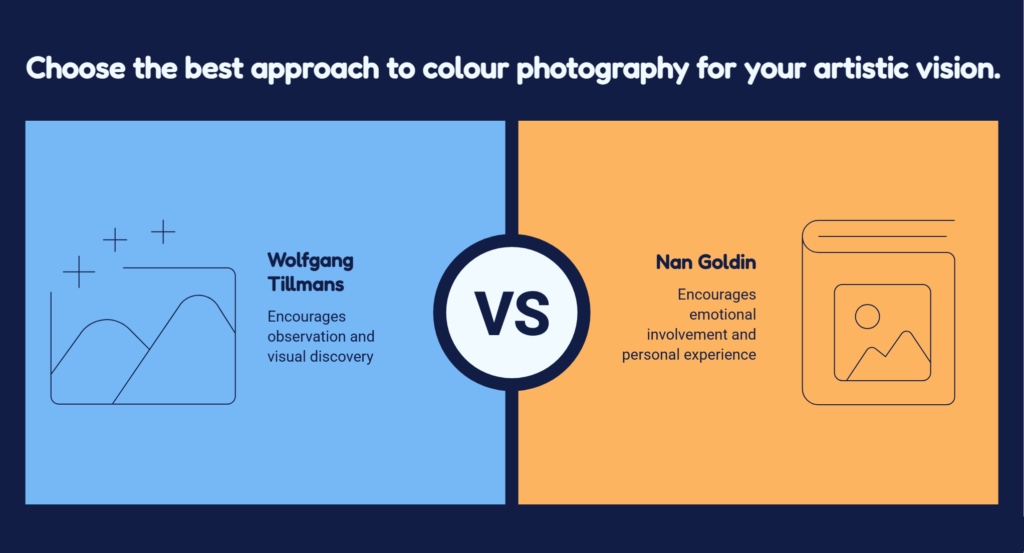
| Viewer response | Encourages observation and visual discovery | Encourages emotional involvement |
You should not describe Tillmans as muted in every photograph or Goldin as saturated in every image. Both artists change their visual approach according to the subject.
The stronger comparison focuses on purpose. Tillmans often uses colour to make you look. Goldin often uses colour to make you feel.
How Does Their Use of Light Differ?
Light creates one of the clearest differences in Wolfgang Tillmans vs Nan Goldin.
Tillmans often works with available light in a way that allows the room or location to remain present. The image may feel airy, quiet, bright, flat, soft,t or naturally uneven.
Goldin frequently uses direct flash in dim environments. The flash separates a person from the room, reveals skin and clothing, freezes a gesture, and allows the background to fall into darker or warmer colour.
What Does Direct Flash Add to Goldin’s Images?
The direct flash photography aesthetic gives Goldin’s photographs urgency.
Direct flash can create:
- Bright faces against dark rooms
- Strong highlights on skin
- Hard-edged shadows
- Visible texture
- Intense colour contrast
- A sense of physical closeness
- The feeling of a private snapshot
MoMA notes that sudden flash often gives Goldin’s work a strong visual contrast to more controlled or conceptual photography from the same period.
In our expert opinion, you should not “fix” this light as though it were a technical mistake. If you soften every highlight, remove each shadow and neutralise the room, you may remove the energy that makes the photograph work.
What Does Available Light Add to Tillmans’s Images?
Available light can preserve the pace of everyday life. It allows you to see where the person stands, how the room feels, and how the subject connects with the environment.
When you edit this type of photograph, you should avoid turning it into a polished studio portrait. A slightly cool wall, bright window, or soft shadow may provide visual context.
The goal is not careless editing. You still need to control distracting colour, weak exposure,e and poor tonal balance. However, you should improve the image without removing its lived quality.
How Do They Create Emotional Storytelling?
Emotional storytelling in photography does not require dramatic facial expressions. Both artists prove that small details can carry strong feeling.
Tillmans may create emotion through distance, silence, body language,ge or the relationship between separate images. A portrait may feel tender because the person looks comfortable rather than because the person performs emotion.
Goldin often creates emotion through continuity. You may see the same friends and partners at different times, in different rooms and during different emotional states. The images become more powerful when you understand that they belong to longer relationships.
How Does Tillmans Create Emotion?
Tillmans often gives you room to interpret the photograph.
He may use:
- A relaxed pose
- An unexpected crop
- A quiet domestic object
- A person looking away
- Empty space around the subject
- A sequence of unrelated-looking images
- Changes in print scale
You do not always receive a complete story. You bring part of your own experience to the image.
How Does Goldin Create Emotion?
Goldin gives you more narrative information, but she does not provide a simple conclusion.
She shows pleasure beside sadness, intimacy beside isolation, and affection beside conflict. Her pictures may feel direct, yet the relationships remain complex.
The Neue Nationalgalerie describes Goldin’s work as a record of intimacy, everyday life, wild parties, autonomy and dependency within her close circle.
When we edit emotionally sensitive photographs, we follow a similar principle: technical improvement should support the feeling, not replace it.
What Do Tillmans and Goldin Have in Common?
The artists differ in method, but they share several important values.
They Respect Ordinary Life
Both artists show that you do not need a grand event to make a meaningful photograph. A bedroom, dance floor, kitchen, street, friend,d or personal object can carry social and emotional meaning.
They Challenge Conventional Beauty
They allow real skin, difficult expressions, imperfect rooms, and unconventional compositions to remain visible. Their subjects do not always perform for the camera.
They Photograph Communities from Close Range
Both artists developed work around friends, youth culture, nightlife, and communities that mainstream photography often ignored or simplified.
They Treat Photography as More Than a Single Image
Tillmans constructs changing wall arrangements with prints of different sizes and subjects. Goldin builds slideshows that combine photographs, sequence, music,c and memory. Their work asks you to experience relationships between images, not only individual frames.
They Protect Ambiguity
Neither artist gives you a neat moral explanation. Their photographs can contain pleasure and sadness at the same time.
How Do Their Compositions Differ?
Tillmans often uses composition as an open field. He may place a person near the edge, include large areas of wall,l or allow ordinary objects to compete with the main subject.
This approach can make the frame feel accidental, but the balance usually remains deliberate.
Goldin often places you close to the action. Her frames may cut through bodies, furniture, or mirrors because she photographs within active rooms and relationships. The composition supports immediacy rather than formal distance.
| Composition feature | Wolfgang Tillmans | Nan Goldin |
| Distance | Moves between close detail and wider observation | Often physically and emotionally close |
| Cropping | Open, unusual and carefully balanced | Immediate, informal and event-driven |
| Background | Often remains visually important | Often carries atmosphere and narrative clues |
| Sequence | Connects different subjects and visual ideas | Builds a personal and emotional history |
| Main feeling | Observation and freedom | Intimacy and urgency |
How Do They Approach Queer Life and Identity?
Both photographers hold an important place in discussions about queer identity in photography, but they approach the subject through people and relationships rather than through simple labels.
Tillmans photographed friends, club communities, intimacy and gay life while also addressing issues such as racism, homelessness and gay rights. Tate notes that political concerns form part of his broader photographic practice.
Goldin photographed drag artists, trans friends, gay men, lesbians, lovers and chosen family from within the communities she shared. Her long-term project The Other Side honours trans friends she photographed across several decades. The Neue Nationalgalerie presents this work as a central part of her artistic practice.
The Berlinische Galerie explains that Goldin photographed Berlin’s queer subculture from a non-voyeuristic position because she lived with and knew many of the people shown in her work.
This distinction matters. You should not treat people as visual trends. Trust, consent, context, and genuine connection shape the meaning of intimate photography.
How Does Berlin Connect Wolfgang Tillmans and Nan Goldin?
Berlin provides an important cultural link between the two artists.
Tillmans became associated with European club culture and later developed strong professional and creative connections with Berlin. His photography reflects the movement between German, British and international art, fashion and nightlife spaces.
Goldin built a particularly personal relationship with Berlin. Her work documented life in the city, and she spent extended periods there after receiving a DAAD scholarship in 1991. German museum sources describe Berlin as an important place in both her life and photographic archive.
Their connection with the Berlin contemporary photography scene helps explain why both artists remain relevant to European viewers.
Berlin offers a setting where art, nightlife, fashion, queer communities, political debate and personal freedom often overlap. Tillmans and Goldin each photographed this overlap differently.
Tillmans often widens the view to include visual culture, politics, objects and experimentation. Goldin brings you close to relationships, memory and chosen family.
Is Wolfgang Tillmans More Experimental Than Nan Goldin?
Tillmans experiments more visibly with photographic formats and materials.
He works across portraits, still life, architecture, social documentation, abstraction, video, publications and gallery installations. He also creates abstract images without a camera by working directly with light and photographic paper.
Goldin also experiments, but she often focuses that experimentation on sequence, sound, time and memory. She repeatedly edits her slideshows, combines still photographs with music and later includes moving images, voice and archival material.
Therefore, you should not call one artist experimental and the other traditional.
Tillmans expands the physical and visual possibilities of the photographic medium. Goldin expands the autobiographical and emotional possibilities of photographic narrative.
Is Nan Goldin More Emotional Than Wolfgang Tillmans?
Goldin often presents emotion more directly, but this does not mean Tillmans lacks emotional depth.
Goldin’s images follow personal relationships and difficult events. You may recognise desire, grief, loneliness or conflict immediately.
Tillmans often leaves the emotion less defined. His images can feel tender, peaceful, sensual, strange or politically alert without telling you exactly what to feel.
The difference involves emotional delivery:
- Goldin often places you inside an unfolding relationship.
- Tillmans often gives you space to observe and interpret.
- Goldin builds emotional intensity through personal continuity.
- Tillmans builds it through attention, association and visual openness.
- Both photographers depend on trust between the camera and the subject.
What Can You Learn from Wolfgang Tillmans and Nan Goldin?
You do not need to copy their subjects, colours or equipment. You can learn more by studying their decisions.
What Can You Learn from Tillmans?
You can learn to notice ordinary details.
Look at how a person sits, how daylight reaches a wall, or how objects create visual relationships. Do not assume that every portrait needs perfect symmetry or dramatic lighting.
You can also learn to edit with restraint. Before removing an unusual shadow or colour cast, ask whether it gives the photograph character.
What Can You Learn from Goldin?
You can learn that trust matters more than visual access.
A close photograph does not automatically become intimate. You create intimacy when your subject feels safe enough to stop performing.
You can also learn to preserve the atmosphere of imperfect light. Direct flash, grain,n and warm interior colour can strengthen the story when they belong to the original scene.
What Should You Avoid?
Avoid turning either artist into a preset.
A “Tillmans look” does not come from lowering saturation and adding grain. A “Goldin look” does not come from placing a red filter over a flash photograph.
Before editing, ask:
- What relationship exists between you and the subject?
- What does the light tell you about the place?
- Which imperfections support the story?
- Does the colour feel emotionally honest?
- Are you protecting the subject’s natural texture?
- Does the final image still feel like a real moment?
How Can You Edit Photos Inspired by Their Work?
Start with the emotional purpose of the image, then make technical adjustments.
For a Tillmans-Inspired Direction
Keep the photograph natural, open and visually curious.
You may:
- Balance exposure without flattening the light
- Protect skin texture
- Keep environmental details
- Use soft or moderate contrast
- Control colour without making it sterile
- Preserve unusual but meaningful crops
- Add gentle grain only when it suits the source image
For a Goldin-Inspired Direction
Protect the energy of flash, colour and personal space.
You may:
- Keep strong flash highlights under control
- Retain warm room colour
- Avoid excessive skin smoothing
- Preserve grain and small imperfections
- Maintain dark backgrounds when they create depth
- Use colour correction without removing the original atmosphere
- Keep the frame close and emotionally direct
In our experience, the best result often comes from knowing when to stop. Over-editing can make an honest image feel artificial.
How Can Professional Retouching Preserve an Artistic Style?
Professional retouching should improve technical quality without erasing the photographer’s visual identity.
At Lume Retouch, we use a Manual + AI hybrid workflow. AI can support repetitive adjustments, but our retouchers make the final decisions about colour, skin, texture, contrast, grain, background detail and overall mood.
For photographers, studios, fashion businesses and creative agencies across the UK, Germany, France, the Netherlands, Belgium, Switzerland, Scandinavia, Southern Europe and Eastern Europe, this balance can support both artistic consistency and efficient production.
We may correct exposure, refine colour, clean distracting details or prepare files for print and digital use. However, we do not force every photograph into the same polished commercial style.
You receive:
- Manual attention combined with AI-supported efficiency
- Natural-looking colour and texture
- Support for JPG, PNG, PSD, TIFF and RAW files
- Delivery within 12–48 hours, depending on volume and complexity
- Unlimited revisions
- Personalised editing support
- Up to 40% discount on qualifying bulk orders
Wolfgang Tillmans vs Nan Goldin: Which Style Is Better for You?
Neither style is universally better.
Tillmans may inspire you more when you enjoy visual freedom, natural observation, mixed subject matter and experimental presentation.
Goldin may inspire you more when you photograph close relationships, personal memory, nightlife and emotionally direct stories.
Choose Tillmans as a reference when you want your images to feel open, observational and visually flexible.
Choose Goldin as a reference when you want your photographs to feel personal, immediate and emotionally connected.
You can also learn from both. You may use Tillmans’s attention to everyday form while applying Goldin’s respect for personal relationships and emotional continuity.
Final Answer: What Does Wolfgang Tillmans vs Nan Goldin Reveal?
Wolfgang Tillmans vs Nan Goldin reveals that honest photography can take more than one form.
Tillmans often turns observation into visual discovery. He moves between people, objects, spaces, politics and abstraction while allowing viewers to create their own connections.
Goldin turns personal experience into an emotional archive. She photographs from within relationships and uses colour, flash, sequence and memory to show affection, desire, conflict and loss.
Both artists prove that meaningful photography does not require perfect conditions. It requires attention, trust and a clear understanding of what the image needs to preserve.
Frequently Asked Questions
What is the main difference between Wolfgang Tillmans and Nan Goldin?
Tillmans often works as an observer who explores people, objects, spaces and photographic materials. Goldin works from inside her personal relationships and builds autobiographical stories about intimacy, friendship and loss.
Did Wolfgang Tillmans and Nan Goldin use the same photography style?
No. Both used candid and informal imagery, but Tillmans developed a broader experimental practice. Goldin focused more strongly on close relationships, direct flash, and personal narrative.
Why does Nan Goldin use direct flash?
Direct flash allows Goldin to photograph in dark bedrooms, bars and clubs. It also gives her images immediacy, visible texture and strong separation between people and their surroundings.
What makes Wolfgang Tillmans’s photography unique?
Tillmans combines portraiture, everyday observation, club culture, still life, politics, abstraction and experimental display. He also changes print sizes and arrangements to shape how you connect different photographs.
Can you edit photographs to look like Tillmans or Goldin?
You can create an inspired direction through colour, contrast, texture and light treatment. However, you cannot recreate the emotional meaning through a preset alone. The subject, relationship, setting and original photograph must support the style.
Get Professional Artistic Photo Editing
Your photographs should retain their original atmosphere, texture and emotional purpose.
Lume Retouch provides professional portrait retouching, colour correction, headshot editing, fashion retouching, background enhancement and bulk image editing for photographers, studios, brands and agencies across Europe and beyond.
Our Manual + AI hybrid workflow gives you editing speed without removing the human judgement that artistic photography requires.
Turnaround: 12–48 hours
Revisions: Unlimited
Bulk discount: Up to 40%
Supported formats: JPG, PNG, PSD, TIFF, and RAW
Contact: Reach Lume Retouch through the official website, email channel, or contact form to request a free consultation and custom quote.