Real estate photography photo editing is not about making rooms look unreal, oversized, or misleading. It is about presenting a property clearly, accurately, and convincingly so buyers understand the space, trust the listing, and feel confident enough to take the next step. In real estate, photography does not sell dreams. It sells clarity.
This page is written as long-form page content with a blog-style flow. It is grounded in real production experience, editing thousands of property images for agents, brokers, developers, and property managers. Everything described here reflects the professional standards used at Lumere Touch, where real estate photography photo editing is treated as a commercial discipline built on accuracy, consistency, and ethical presentation—not shortcuts or exaggeration.
What Real Estate Photography Photo Editing Actually Means
At its core, real estate photography photo editing is the process of refining property images so they accurately represent space, light, and layout while remaining visually appealing across digital platforms.
Professional real estate photo editing focuses on:
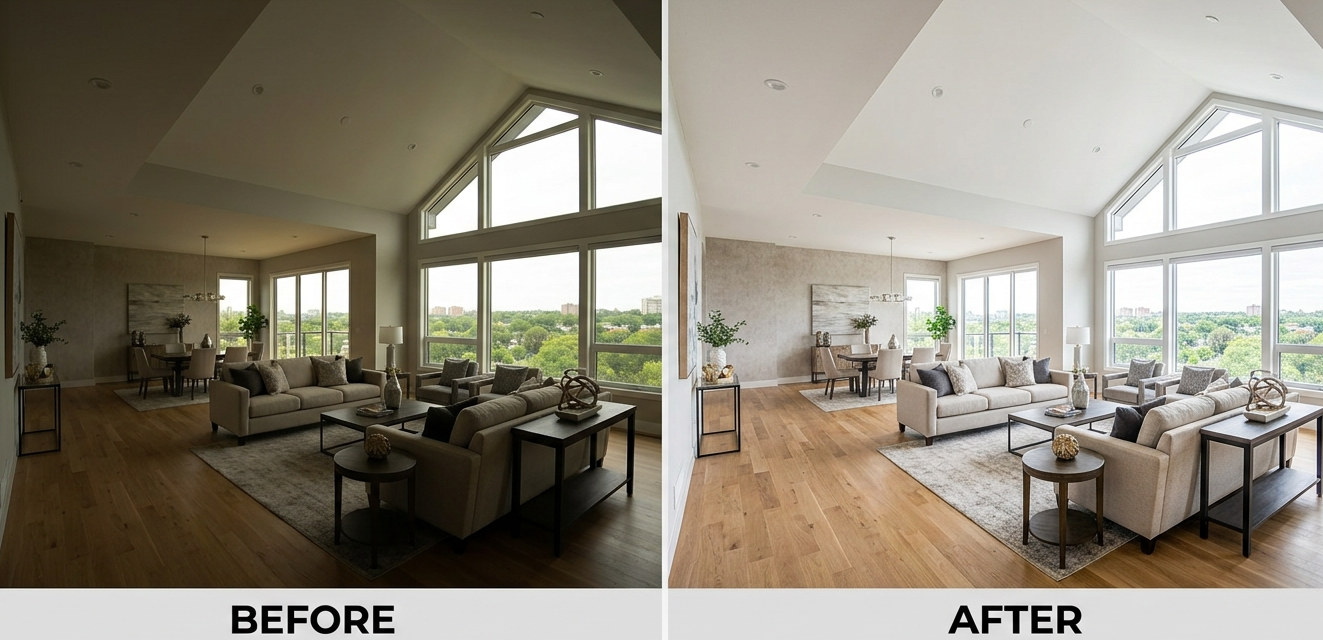
Correcting exposure and lighting imbalance
Preserving realistic colors and materials
Enhancing clarity without distortion
Ensuring visual consistency across listings
Supporting buyer trust and agent credibility
At Lumere Touch, every edit is judged against one principle: Would this image still feel honest if the buyer walked into the property tomorrow?
Why Real Estate Photo Editing Is Different from Other Photo Editing
Real estate photography editing is not artistic freedom. It is controlled precision.
Unlike fashion, portrait, or creative editing:
Walls must stay straight
Room sizes must remain truthful
Windows must not blow out or fake views
Colors must match reality
The goal is not “wow.” The goal is confidence.
This is why professional real estate photography photo editing requires specialized judgment.
The Role of Editing in Modern Real Estate Marketing
Buyers form opinions in seconds.
Before:
Reading descriptions
Viewing floor plans
Contacting agents
They judge the property by images alone.
Well-executed real estate photography photo editing:
Increases listing engagement
Reduces unnecessary showings
Attracts more qualified buyers
At Lumere Touch, editing is treated as a sales support system, not decoration.
Editing Starts with Understanding the Property
One of the most overlooked aspects of real estate photography photo editing is context.
Editors must understand:
Property type (apartment, villa, commercial)
Target buyer profile
Listing price range
The platform where images will appear
Luxury properties require restraint. Entry-level listings require clarity. Editing strategy changes accordingly.
Exposure Blending: A Core Technique in Real Estate Photo Editing
Interior spaces challenge cameras.
Common issues:
Dark rooms with bright windows
Uneven lighting
Mixed color temperatures
Professional real estate photography photo editing uses exposure blending to:
Balance interior light
Preserve exterior views
Maintain natural contrast
At lumere touch, exposure blending is manual—not automated—to ensure realism.
Window Pulls Without Fake Views
Window views matter—but only when they are real.
Best practices include:
Using actual captured exterior exposures
Matching light direction and intensity
Avoiding stock sky replacements
Fake views damage credibility. Ethical editing protects long-term agent reputation.
Color Accuracy and White Balance in Property Images
Incorrect color misrepresents materials.
Problems caused by poor color editing:
Yellow or blue walls
Misrepresented flooring
Artificial warmth or coolness
Best practices for real estate photography photo editing require:
Neutral white balance
Subtle color correction
Material-accurate tones
At lumere touch, color is corrected to match real-world appearance—not mood trends.
Vertical and Horizontal Line Correction
Crooked walls instantly reduce perceived quality.
Professional editing includes:
Vertical correction (walls, doors, windows)
Horizontal leveling (floors, ceilings)
Over-correction can distort space, so precision matters.
Perspective Control Without Shrinking Rooms
Wide-angle lenses exaggerate space—but can mislead.
Editing best practices include:
Correcting lens distortion
Preserving realistic proportions
Avoiding “fishbowl” effects
Real estate photography photo editing should clarify space, not manipulate it.
Sky Replacement: When and When Not to Use It
Sky replacement is controversial.
Ethical best practices:
Replace only when the sky is blown out
Match the lighting direction
Use subtle, realistic skies
At Lumere Touch, sky replacement is optional, conservative, and never deceptive.
Interior Detail Enhancement
Details sell quality.
Editing focuses on:
Texture clarity
Balanced contrast
Clean surfaces
Over-sharpening or over-clarity makes interiors feel harsh and artificial.
Object and Distraction Removal
Removing distractions improves focus—but must be done ethically.
Acceptable removals:
Small cords
Trash bins
Minor clutter
Unacceptable removals:
Structural elements
Permanent fixtures
Size-altering edits
Real estate photography photo editing should reduce noise, not reality.
Consistency Across a Property Set
One strong image does not sell a property. A consistent set does.
Best practices include:
Uniform brightness
Matching color temperature
Similar contrast levels
At Lumere Touch, all images in a listing are edited as a single visual system.
Editing for Different Property Types
Residential Homes
Warm but neutral tones
Inviting light balance
Luxury Properties
Subtle contrast
Minimal manipulation
Commercial Spaces
Clean lines
Functional clarity
Editing strategy adapts to the use case.
Real Estate Photography Photo Editing for MLS and Portals
MLS platforms compress images.
Best practices:
Export optimized resolutions
Avoid excessive sharpening
Test final uploads
Editing must survive compression without quality loss.
Editing for Mobile-First Buyers
Most buyers view listings on phones.
Best practices include:
Clear subject separation
Avoiding tiny details
Balanced brightness
Images must read well on small screens.
HDR: Tool, Not Solution
HDR is often misused.
Problems with automated HDR:
Halos
Flat contrast
Unnatural tones
Professional real estate photography photo editing uses HDR selectively or avoids it entirely in favor of manual blending.
Non-Destructive Workflow in Real Estate Editing
Non-destructive editing allows:
Revisions
Platform adaptation
Style evolution
At Lumere Touch, original files are always preserved.
File Organization and Delivery Standards
Professional editing includes:
Logical naming
Organized folders
Clear delivery formats
This saves agents time and supports scalability.
Turnaround Time vs Quality Balance
Fast delivery matters—but not at the expense of quality.
At Lumere Touch, turnaround times are structured without sacrificing precision.
Ethics in Real Estate Photography Photo Editing
Misleading edits lead to:
Buyer disappointment
Wasted showings
Legal risk
Ethical editing builds trust and long-term success.
Editing for Branding and Agent Identity
Agents build recognition through consistent visuals.
Editing best practices include:
Recognizable color treatment
Consistent brightness
Predictable style
This strengthens brand recall.
Pros & Cons of Professional Real Estate Photography Photo Editing
| Pros | Cons |
|---|---|
| Higher buyer engagement | Editing cost |
| Faster property interest | Requires skilled editors |
| Improved listing quality | Time investment |
| Stronger agent credibility | Learning curve |
| Better platform performance | Consistency effort |
Why Professionals Choose Lumere Touch
Clients work with Lumere Touch because:
Editing decisions are intentional
Realism is protected
Consistency is enforced
Ethics guide every adjustment
Real estate photography photo editing is treated as a business tool, not a visual trick.
Scaling Real Estate Editing Without Losing Quality
As volume increases, systems matter.
Best practices include:
Editing guidelines
Reference sets
Quality checks
This allows growth without degradation.
Real Estate Photo Editing and Buyer Psychology
Clear images:
Reduce uncertainty
Increase confidence
Improve emotional response
Editing supports decision-making, not illusion.
Long-Term Value of High-Quality Real Estate Editing
Good edits:
Improve brand reputation
Reduce reshoots
Support faster sales cycles
Images become long-term marketing assets.
Common Mistakes in Real Estate Photography Photo Editing
Over-brightening
Fake skies
Crooked lines
Oversaturation
Excessive clarity
Avoiding these mistakes separates professionals from amateurs.
Real Estate Photography Photo Editing as a Competitive Advantage
In saturated markets, visuals differentiate listings instantly.
Consistent, ethical editing gives agents an edge.
Frequently Asked Questions About Real Estate Photography Photo Editing
1. What is real estate photography photo editing?
The process of refining property images for clarity, accuracy, and presentation.
2. Is real estate photo editing ethical?
Yes, when it preserves truth and avoids misrepresentation.
3. Should rooms look bigger after editing?
No. They should look clear and proportional.
4. Is sky replacement acceptable?
Only when done subtly and realistically.
5. How important is vertical correction?
Critical. Crooked lines reduce perceived quality.
6. Can editing fix poor photography?
Only to a limited extent. Good capture matters.
7. Is HDR recommended?
Manual blending is preferred over automated HDR.
8. How consistent should listing photos be?
Very. Consistency improves buyer trust.
9. Does editing affect MLS performance?
Yes. Optimized images perform better.
10. Why choose Lumere Touch?
Because Lumere Touch delivers ethical, precise, and scalable real estate photography photo editing built on experience.